Resources from the Garden Club of Switzerland Florida Go to the About Us Page Go To the Awards and Projects Page go to the Events and Calendar page Go to the Home Page

Tuesday, February 12, 2019

Fresh Vegetables -- Spelled Y-U-M

fresh vegetables
Keep in mind that grow-your-own veggies will need more washing than the pre-washed ones you get in the store.  A few cleanup procedures before eating will minimize any sand clinging to the vegetable.

Tricks and supplies for cleaning your fresh treasures:

  • Soak:  Let gravity do some of the cleaning and soak the vegetable before starting any other cleaning steps. Fill a big bowl with tap water (or filtered from the tap - your preference).  Then let the vegetables soak in the water for 15 minutes, then remove the vegetables from the water.  For sandy leafy vegetables, such as spinach, kale, mustard, or chard, you may need to repeat this process a few times.  
  • Scrub:  Use a vegetable brush on the plant while you rinse it off.  Skip this step if cleaning leafy veggies.  Some stores sell soap formulated to clean vegetables.  If your vegetables are just sandy, it's probably not necessary.  But if you are cooking for someone with an immune deficiency or a small child, you might want to consider this.
  • Rinse and drain.
  • Prepare.  For the healthiest eating do NOT remove the skins.  They are LOADED with vitamins.  And YES YOU CAN learn  to enjoy this part of the vegetable.  Even carrots in a salad don't look unappetizing if you keep in mind how much the skins benefit YOU!  OK, you can peel your beets and pumpkin, etc... Unless you want to cook your pumpkin pie in a shell...  :)  See "What Part of the Plant are You Eating (and Cooking)" for the "First Pumpkin Pie (sort of)" recipe that makes the shell part of the pie from PBS's Autumwatch series.  Well, I did NOT get my husband to eat the shell, but I DID!!!!

Recipe tips:

Deborah took home a sweet potato, microwaved it, and used it as a healthy snack while she ran errands.  And YES you CAN:  eat the skins, that is.  An average size sweet potato should be microwaved on high for around 5 minutes.  Test it by sticking a fork into the flesh; if it feels moderately soft, it's ready to cool and eat. Remember that the potato will continue to cook AFTER it has been taken out of the microwave. If it's still hard, rotate the potato so the bottom is on the top (to cook it more evenly) give it another minute and test again.

Traditional southern recipes for winter greens (mustard, kale, collards) prepare them by cooking in water and flavoring the "juice" with bacon or salt pork.  As a "northern girl" I prefer to saute them in a vegetable oil (adding a little water to keep them from drying out.  I mix the prepared greens with sauteed sweet onions and a dash of sugar to take away some of the bitter taste.  With strong-flavored mustards I add some sesame oil and mix them into an oriental stir-fry.

Arugula, it's not just for salads!  The peppery taste of arugula can spice up a lot of foods.  Mickey's son added it to pasta, giving this classic dish a savory kick.

Kohlrabi is a popular European vegetable.  Both the stems/leaves and bulbs are edible.  The leaves can be sauteed like winter greens (see above).  The bulb can be cooked in water and prepared like mashed potatoes or soup, or roasted or sauteed and flavored with garlic, Parmesan cheese or herbs.  Young and tender kohlrabi may be eaten raw, without peeling.


Monday, January 21, 2019

A Phenomenon Called The Super Blood Wolf Moon Eclipse

First Nation's peoples had many names for the first moon in January.  One name we've appropriated is the, "wolf moon."  January is the month the nocturnal wolves howl.  Any moon eclipse makes the moon look red, and that's where the name, "blood moon," comes from.   The "super" refers to the size of the moon in the sky.  The next two months will all feature "super moons."

While Florida was expected to be cloudy on Sunday night, old man winter surprised us with a cold and clear sky, giving us the opportunity to see this phenomenon.  Although some people are disappointed that the moon does not look as dramatic as they expect (certainly not as dramatic as the sun in full solar eclipse), I suggest at the next lunar eclipse (in 2021) they take a few minutes to look at the rest of the sky, feel the change in the atmosphere and wind, and listen to the silence of the nocturnal animals.  Waiting for the solar eclipse gives you the same experience amplified, except the stars aren't particularly bright.

I got up last night just before midnight and hunkered down on the lanai steps.  Even though there was more ambient light than I'd liked, I was still amazed by the stars shining with an ethereal light.  Venus was so blue it almost glowed lavender.  As the constellations floated westward, I felt the wind pick up, tossing the tree branches to and fro - and then stop in a chilly quiet.  That same atmospheric response happened just before the 2017 solar eclipse in South Carolina.  Even the wildlife held its breath.  Before the solar eclipse the birds fell silent.  Before the lunar eclipse the frog's mating calls across the pond diminished then extinguished.  The dim red moon held court, spectators reduced to awed silence.

This morning around 6AM, the triumphant moon, radiating like a prize pearl,  slid below the trees, leaving only Venus basking in the fading glory.

Enjoy photos of the event and learn more about phenomenon called a lunar eclipse and a rare meteorite strike that happened during the event:

Looking ahead:  January 26 at 9AM in Alpine Groves Park, water from three rivers, brought to the park by their Riverkeepers will be honored in ceremony then returned to their rivers of origin.  After the event, you are welcome to enjoy a tour of Beluthahatchee Park (just across the street) and learn about Stetson Kennedy, his lifelong homestead, and dear friend, Woody Guthrie.  See more info on this event and how you can help your neighbors during the government shutdown at January Items in www.firstcoastflora.info.

Saturday, December 1, 2018

What Part of the Plant are You Eating and Cooking?

With holiday season upon us, we often eat foods that are especially associated with the holidays:  pumpkin pie, candied yams (sweet potatoes), cranberries, and greens.   We may think we know what part of the plant we are eating, but sometimes the shape or its similarity to other plant parts fools us.  We even call certain plants, such as the tomato, "vegetables," when in fact the part we eat is the fruit of the tomato plant.  Botanic definitions can differ from common language usage.

So here's a quiz to test your knowledge of the botanical parts of the plants you eat.  It's based on the quiz Barbara gave us:

https://drive.google.com/open?id=1ObhQ5wCn51mtWHBZMfuG7SJequkKlZnq

The answers can be found here:

https://drive.google.com/open?id=1X9KFYknBp77Ygygg84L-pYOFZNYTz_Eo

They are based on the University of Florida's 4H horticultural curriculum:
http://sfyl.ifas.ufl.edu/sarasota-docs/4-hrecordbooks/Judging_Hort.pdf

And if all of this "brain work" has given you an appetite, check out a pioneer recipe for "The First Pumpkin Pie - Sort of" from the PBS AutumnWatch New England series.


Dianne made her own healthier version of the pie from a "pie pumpkin."  She cut the pumpkin in half along its "equator" and roasted it until the flesh was soft.  She used the bottom half of a baked  pie pumpkin for the shell, and hollowed out the baked flesh of the top half to make the pumpkin filling adding brown sugar, spices, and condensed milk.  She skipped the fruit and spices that were called for in the recipe and used some of Trader Joe's Pumpkin Butter - so easy and tasty!  Too bad the Puritans didn't have a store nearby... She poured the pumpkin filling into the shell and baked it at 350 until the filling was "set."  Let the filling cool, then slice and serve right from the pumpkin shell.  You can eat the shell and skin (or not if you don't like the skin texture).

If you are a purist, you can even use the native American Seminole pumpkin instead of the European variety.  Seminole pumpkins have very hard shells, but your reward for halving them for baking is their especially sweet meat.

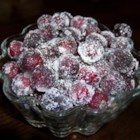
frosted cranberriesThis year we had a bumper crop of cranberries, so why not take advantage of the harvest, and add frosted cranberries to your dessert or snack table?  Choose only very fresh berries and use them before they start to turn soft.  The frosted cranberries can be stpred in the refrigerator and brought out an hour or two before serving time.  They do have a limited shelf life, but don't worry - your diners will make short work of them.  See the recipe at the FirstCoast Flora Luncheon Recipes page.

Of course, you know now that BOTH pumpkin pies and frosted cranberries are made from the FRUIT of the plant!


Friday, March 3, 2017

More About Monarchs!

Click here for photo credit:
Male Monarchs have a dot on their upper hind wings.
Oh yes, the Monarch Committee can't get enough of monarchs.  While our unseasonably warm weather allowed us to enjoy monarchs this winter, we're watching to see how the great migration of monarchs returning from Mexico goes.  Last year, the reserve got hit by a late season snowstorm.   Excessive snowfall and high winds killed many butterflies and the firs that protect them from the elements.  So far, the weather has been kinder, so we're crossing our fingers.

The article, "Monarchs on the March," mentions more information and videos available at our website.  Here they are:


And, in case you missed them, here our past postings on monarchs from beginning to the present:

Thursday, October 27, 2016

Reuse, Recycle, Renew, Repurpose from A to Z

Our secretary, Mickey Fraser, gave us an outstanding presentation on recycling from A to Z.  There isn't a letter of the alphabet that she can't cover.  Unfortunately, an hour was not enough time to get through all the ideas she had.  Her presentation will be posted soon.

Dianne told the members about the dangers of microplastics, tiny beads of plastic that are too small to be filtered out by water sanitation facilities.  These microplastics our found in our oceans (and drinking water) and pollute it and the creatures living in it, to their (and our) detriment.  September was microplastics awareness month at IFAS UF.  Be aware by looking at the ingredients in the products you buy, from toothpaste to body scrub.  If you see polyethelene in the list, do not buy the product.  Dianne brought two tubes of toothpaste in, one with and one without the ingredient.  The "named" brand was the one WITH polyethylene.  Bottom line:  read the labels.

And switch to an environmentally-friendly cat litter.  Healthier for you, the cat, and the environment.